
News
VerenA increases its contribution to climate protection in 2025 – 865 tonnes of CO₂ saved since launch in 2023
The VerenA take-back system further increased its contribution to climate and resource protection in 2025. Through the collection and recycling of used Big Bags, 371 tonnes of CO₂ were saved during the latest collection period. This corresponds to 3,226,678 car kilometres, the average annual mileage of 257 cars, or the annual CO₂ sequestration capacity of 26,720 trees.
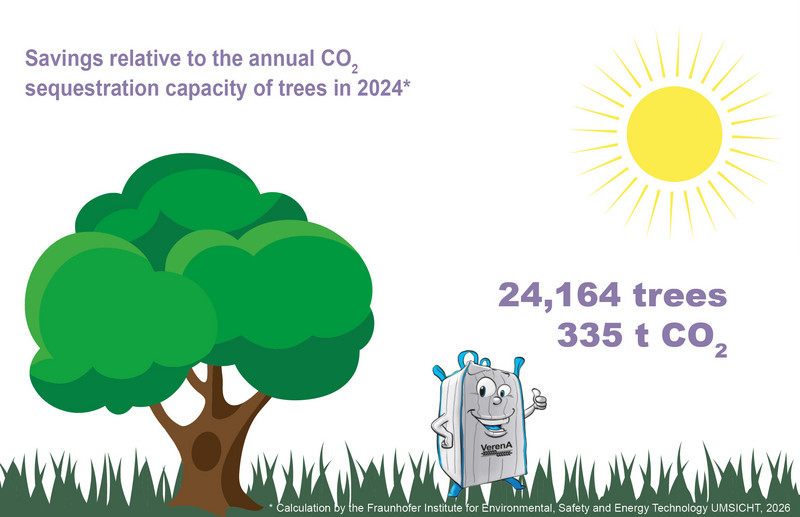
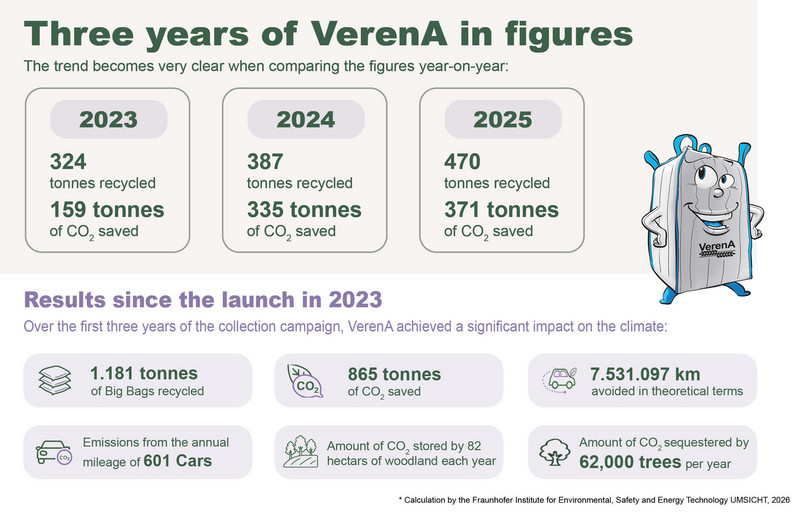
Since its operational launch and first collection in 2023, VerenA has shown a clear development: the system is growing – and so is its impact on the circular economy. In total, 1,181 tonnes of Big Bags were recycled during the first three collection years. This resulted in cumulative savings of 865 tonnes of CO₂. To put this into perspective, this is equivalent to around 7.53 million car kilometres, the annual mileage of 601 cars, or the annual sequestration capacity of 62,366 trees.
“The figures clearly demonstrate that the circular economy also delivers measurable climate benefits when it comes to used Big Bags. Every tonne collected and recycled helps to replace primary raw materials and avoid emissions,” says Jens Dambeck, VerenA System Manager.
Growth in volumes and contribution to climate protection
The positive trend is reflected both in the quantities collected and in the climate impact achieved. Following 324 tonnes recycled in 2023 and 387 tonnes in 2024, the volume increased to 470 tonnes collected in 2025. Annual CO₂ savings also developed dynamically: from 159 tonnes of CO₂ in the launch year to 335 tonnes in 2024 and now 371 tonnes of CO₂ in 2025.
The increase from 2023 to 2024 was particularly significant. In 2025, this high level was further expanded and stabilised. The saving per tonne collected and recycled stood at 0.79 tonnes of CO₂ per tonne in 2025, compared with 0.87 tonnes of CO₂ per tonne in the previous year and 0.49 tonnes of CO₂ per tonne in 2023.
Why the climate impact is so significant
The evaluated climate data show that although emissions arise along the recycling route from delivery, acceptance, transport and processing, these are clearly more than offset by the benefits of material recycling. In 2025, emissions from delivery, processing and transport totalled 106.97 kg CO₂ equivalents per tonne of input. This was offset by a recycling value of -895.91 kg CO₂ equivalents per tonne of input.
[The negative value represents a calculated credit and is based on the assumption that the secondary products generated – in particular plastic regranulate and recovered energy – substitute corresponding primary products. The credit results from a comparison between secondary production and the respective avoided primary production and should not be equated with an absolute reduction in emissions.]
Across the entire recycling route, this results in total savings of 789 kg CO₂ equivalents per tonne of input.
The greatest leverage comes from material recycling, with -937.60 kg CO₂ equivalents per tonne of input in 2025. This demonstrates how effective returning material to the cycle can be: by using secondary raw materials, emissions can be avoided that would otherwise arise from the production of virgin material.
“VerenA is a prime example of how a practical take-back solution can create real added value for companies, the environment and resource conservation. The development since 2023 proves that acceptance, participation and impact can grow together,” summarises Ingrid Krieger, Sales Manager at RIGK GmbH.
Strong network, clear further development
With more than 280 collection points across Germany, the VerenA SYSTEM, launched in 2023, is now firmly established in the agricultural sector. Expanded inspections help to safeguard the quality of the take-back process and ensure that the system can continue to develop reliably, even as volumes increase.
VerenA therefore underlines the potential of effective take-back and recycling solutions for plastic packaging used in agriculture. The system combines practical disposal reliability with a transparent climate impact and makes the benefits of the circular economy visible through concrete figures.
Farms and distributors are invited to return their VerenA-licensed packaging again in 2026 and actively contribute to the circular economy. VerenA recommends checking that packaging is correctly labelled before delivery and making contact at an early stage if any questions arise.
Further information and contacts
Jens Dambeck
System Manager
+49 (0)611 308600-38
j.dambeck(at)rigk.de
Ingrid Krieger
Sales Manager, RIGK GmbH
+49 (0)611 308600-49
krieger(at)rigk.de